
It’s most powerful when there is no live sound or it goes completely silent. In the opening scene a suicide bomber runs into a crowd and detonates. It’s not surprising, as our main character is a war correspondent. What is jarring is that the suicide bomber is American and is running into a crowd of Americans holding an American flag in America.
During the silence and quiet the audience relives the war correspondent, Lee Smith’s, nightmares; immolations, beatings and murders. The quieter the movie the more intense the drama. This is the first five minutes.
Alex Garland has written and directed this masterpiece. The casting is outstanding. Kirsten Dunst is pitch perfect as Lee Smith, a grizzled war photographer. Her one-thousand-yard stare and deadpan delivery recall Rosamund Pike’s performance as the late journalist Marie Colvin in A Private War. Garland also wrote and directed Ex Machina, a 2014 movie about the pitfalls of artificial intelligence.
As life slips away from one of the main characters, the silence of the chaotic scene around him is sublime as the story is narrated by a slow country song. The world seems to be ending and as paved streets turn into gravel Garland’s backdrop is a cinematic silver lining. The song flows along as the coolest of all the reporters appears to have a nervous breakdown.
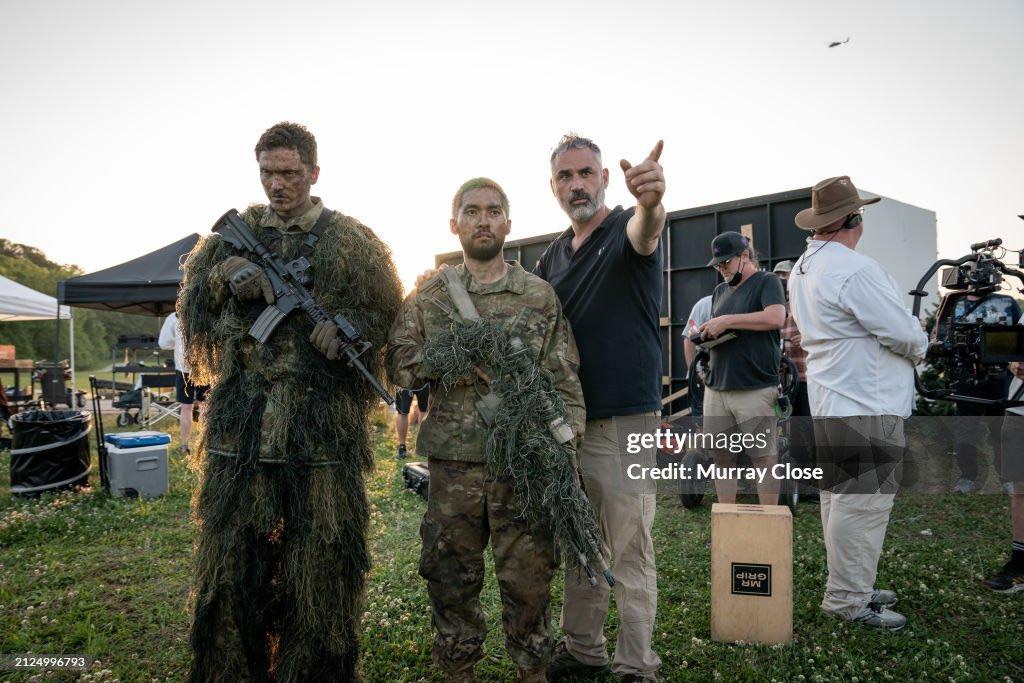
The lyrics, “it was all a dream,” play as the scene shifts to the Western Forces mobilizing for its final assault on Washington, D.C. The flag waving in the wind appears to be an American flag but has only two stars.
Both sides are racially and ethnically mixed so it’s impossible to tell which side is conservative or progressive. The Western Forces might seem to be conservative as it includes Texas but it also includes California. The President might seem conservative or liberal, as he has dismissed the FBI. It’s notable that he is in his third term.
This is well done because the movie is not about politics – at least not the partisan variety. Of course, it is entirely political in a Clausewitz-ian context. The Prussian General Clausewitz explained, “war is politics through other means.” Civil War is a battle between and among Americans.
The movie isn’t for everyone. Those who didn’t understand the foresight or nuance of Ex Machina, likely won’t get this film. Many on the left, like The New Yorker film critic, Justin Chang, didn’t get it. Chang won a Pulitzer Prize but couldn’t accept that the movie did not single out conservatives as the villains. He accused Garland of playing identity politics in the scene that most effectively destroys any notion that far-right white nationalism is a legitimate American ideology.
The breakdown is paced so that there are minor dysfunctions followed by a total collapse. The collapse, the chaos, the dysfunction and the unpredictability are the message. The director Alex Garland knew the domestic politics aren’t important because it doesn’t matter who would start it. What really matters is if it happened and what it would mean.
The idea of a civil war presupposes a structure; two sides are organized against one another. Garland realizes there is a larger sociological context when order dissolves. The vacuum of authority would be filled by freelancers. The scenes with the freelancers are harrowing.
The correspondents stop for gas and offer $300 for half a tank. The locals blow them off, until they mention it’s Canadian dollars. The local militia has beaten to a pulp and hung two looters. The most harrowing thing is they are still alive. The freelancer keeps his assault rifle handy and causally explains, “we can’t figure out what to do with them.”
The climax of the movie is a massacre. The situation is ripped from a 1995 headline of ethnic cleansing in Srebrenica (the former Yugoslavia). Is the two man death-squad part of the Western Forces or are they on their own?
In contrast, there is a community which decides to ignore what is going on. The crew of correspondents and photojournalists pass through to remind the viewer of the vacuum and the wide expanse that is America. Some cities are bombed into rubble, while in other areas people live peacefully in the countryside.
Eventually, the correspondents embed with the Western Forces and head to D.C. The three correspondents follow the action with such reckless abandon the audience comes to realize they may all die. When it comes to iconic endings, Garland doesn’t disappoint.




 The Florida Squeeze