
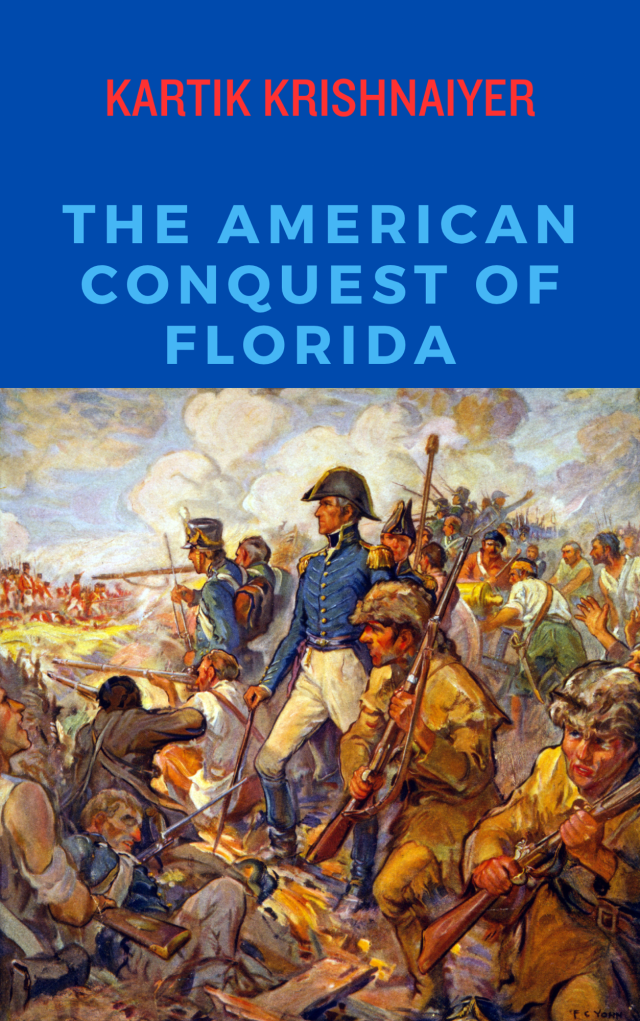
With President Trump gung-ho on conquering new territory for a revived vision of manifest destiny we remember when the US looked to conquer Florida. The following excerpt is from my new book on the War of 1812 and its connections to Florida.
The goal when negotiating the Louisiana Purchase had been to get New Orleans as the port and entry point to the Mississippi River and West Florida. They were more concerned about Florida for obvious reasons if you just think of geography.
Obviously the Louisiana Purchase ended up being one of the great bargains in world history. But at the time, many lamented not acquiring Florida, which was directly adjoining the southern US and had been such a nuisance to the Patriots during the Revolutionary War.
Thanks to the Northwest Ordinance, Americans were beginning to settle what is now the Midwest, but in the early 1800’s Florida was a much more immediate concern for the fledgling United States. Many Americans were perplexed and even angry at Jefferson’s negotiators.
How could the fledgling United States possibly spend $15 million and not get Florida?

1806 map by John Cary indicates West Florida was not part of the US claim on Louisiana
The “Florida question” in Congress
In 1804, US Secretary of State Madison attempted to correspond with France on the matter of Florida. French Foreign Minister Talleyrand had this reply:
France, in giving up Louisiana to the United States, transferred to them all the rights over that territory which she had acquired from Spain. She could not nor did she wish to cede any other; and that no room might be left for doubt in this respect, she repeated in her treaty of 30th of April, 1803, the literal expression of the treaty of St. Ildefonso, by which she had acquired that colony two years before. Nor was it stipulated in her treaty of the year 1801 that the acquisition of Louisiana by France was a retrocession; that is to say that Spain restored to France what she had received from her in 1762. … The same day France ceded to England by the preliminaries of peace, all the territory to the eastward. Of this Spain received no part and could therefore give back none to France. All … bears the name of Florida. It has been constantly designated in that way during the time that Spain held it. It bears the same name in the treaties of limits between Spain and the United States; and in different notes of Mr. Livingston of a later date than the treaty of retrocession in which the name of Louisiana is given to the territory on the west side of the Mississippi; of Florida to that on the east side of it. You must think as unnatural, after all the changes of sovereignty which that part of America has undergone, to give the name of Louisiana to the Mobile district as to territory more north of it, on the same bank of the river, which formerly belonged to France. These observations, sir, will be sufficient to dispel every kind of doubt with regard to the extent of the retrocession made by Spain to France. … It was under this impression that the Spanish and French Plenipotentiaries negotiated. During the whole course of these negotiations, the Spanish government has constantly refused to cede any part of the Floridas. Moreover, Gen. Bournouville was charged to open a new negotiation with Spain for the acquisition of the Floridas. His project which has not been followed by any treaty is an evident proof that France had not acquired by the treaty retroceding Louisiana the country east of the Mississippi.
Since it was clear the French were not budging, the US needed to find another solution. Therefore, the “Florida question” dominated proceedings in Congress from 1804 to 1807.
Congress first passed “The Mobile Act,” which was a clear test of Spanish sovereignty. It claimed the waterways leading south into the areas of what are now the Gulf Coasts of Alabama, Mississippi and Florida were in fact American territory.
This proved difficult to enforce and while President Jefferson wanted to test Spanish resolve he now sought to negotiate the acquisition of Florida directly.
In 1804 and 1805, James Monroe was sent as a special envoy to the capitals of Europe to negotiate the West Florida question. His initial goal was to secure the lands east of Perdido River.



 The Florida Squeeze