
This book is published by our publishing Arm.
It’s difficult for modern Floridians to conceive what prohibition was like even with dry counties in the parts of the state persisting into this millennium. It was a different time – a time of intense factionalism and “wets versus dries” defining everything about a person or an elected official. The country was divided in such a manner that was hardly recognizable until today. People’s entire life and ideology were defined by whether or not they were wets or dries. It’s difficult for many in our state to really grasp how important the era was to defining the state that emerged out of the shadows of the 1920’s to the bustling, modern mega-state of today.
Splits between wets and dries characterized political and societal life throughout the nation. Florida was no different but as a southern, largely religious state with a population that at the beginning of the era was skewed toward the northern part of the state where dries dominated but by the end of the prohibition era was more balanced with huge growth in the south where wets were more prevalent than up north made it unique. Florida’s willingness to allow local municipalities to implement prohibition long before the Volstead Act passed made it a contentious issue that divided Floridians in a state that was rapidly changing for three decades.
Urbanization and immigration were leading triggers on the move for prohibition throughout the country. A fear of outsiders and a loss of simple agrarian life that was being corrupted by the bottle and vices that come with alcohol were leading justifications for dry movements that sprung up throughout the hinterland in the late 1800’s and early 1900’s.

Carry Nation the country’s leading prohibitionist activist visited Florida in 1908 touring the state. Nation’s impact was profound – politicians joined her call for prohibition as did many housewives and non-political activist types. Nation’s visit helped many local municipalities push through ordinances making towns, cities and counties “dry” before the Volstead Act imposed prohibition nationally. The impact of Nation in many small towns was pronounced. Making areas “dry” became the sole political issue in many places as early as the 1908 election.
In one-party Florida as with the rest of the south, politics would fall upon tribal or single issue lines. From the late 1910’s until the last 1920’s the most important issues in the south were related to prohibition and race. Often times being soft on prohibition implied a certain liberalism on race and immigration in the eyes of those who were prohibitionists. But ethnic diversity was coming to Florida and the prohibition era captivated this.
In 1916, as prohibition was becoming the dominant domestic issue particularly in rural areas
Sidney Catts was elected Governor of Florida after being denied the Democratic nomination in a recount. Catts secured the nomination of the Prohibition Party and was elected. Catts talked extensively about political & bureaucratic reform and married that rhetoric with anti-catholicism and overt racism. Catts electoral success showed the ability of someone associated with being “dry” to buck the established Bourbon Democratic Party establishment and get elected. Catts showed how popular prohibition was among rural conservatives. Catts though a registered Democrat was the only person running on a line other than the Democratic one to win the Governorship between Reconstruction and the 1966. The attitudes of those rural folk who had been captivated by Nation’s 1908 tour and pushed their local officials towards prohibition helped to carry Catts to victory.
Catts’ victory led the legislature to actually impose a form of prohibition statewide BEFORE the Volstead Act was passed. While Florida’s governing northern rural counties remained dry and conservative in this period for the most part other parts of the state, far-flung from the centers of power in the 1910’s and 1920’s took a different approach.
Developments would soon after the imposition of state laws and the Volstead Act demonstrate how absurd a notion prohibition was in general for a state as large and diverse as Florida was becoming. With ethnic Italians and Cubans moving into the peninsular portion state, and Catholics in general nationally “wetter” than other groups, the landscape was changing forever in the Sunshine State. These fault lines which were becoming apparently politically in the late 1910’s would be exposed once and for all in the 1920’s. In an era before interstate highways and the Florida Turnpike, before jet airplanes, before the internet and television, communications were delayed and often limited between the northern rural areas which governed Florida and the south where prohibition was disdained.
Consistently tension in Florida politics and society in the early and mid 1900’s revolved between the rural north with most of its residents tracing their southern lineage to Georgia, Alabama, Mississippi or South Carolina with the rest of the state who was filling up with people from the north and even abroad was only beginning to percolate when prohibition was implemented. The Florida land boom coincided with prohibition and made the implementation of dry laws absolutely unrealistic beyond the small towns and rural conservative counties of the Panhandle and Big Bend.
A vast, sprawling peninsula lay below the areas where prohibition was popular and it became almost impossible for law enforcement officers to force the laws on those areas. Much like the Seminole’s and other native americans who had fled south into the vast hinterland of the state to remain “unconquered,” bootleggers drifted to Florida, particularly the Miami/Fort Lauderdale area. Shootouts were common and law enforcement officials had a very hard time tracking bootleggers. Meanwhile gambling became commonplace and levels of public corruption among elected officials and bureaucrats reached levels never seen in the state’s history. Law enforcement itself wasn’t immune and prostitution became more prevalent. It was an era that shaped much of the identity of South Florida and other parts of the state where prohibition was not welcomed by large portions of the population and businesses.
Prohibition exposed fault lines in the state like so little before it. Miami was rapidly becoming a major city, growing from small village in 1900 to Florida’s largest city by 1930, the area was developing a an outlaw reputation. The thirteen years of Prohibition helped to define South Florida.
In 2008 The Miami Herald reflected on the era:
In Miami and Fort Lauderdale, [the ban on booze] ushered in 13 years of illegal drinking, gambling, prostitution, rum running, high-seas machine-gun battles, public corruption and general scorn for the law. For all the notoriety of the mobbed-up ’50s, the cocaine-cowboy ’80s, even the hopped-up club scene of today, it was the most protracted and pervasive period of lawlessness and debauchery this region has known.
Miami and Fort Lauderdale do have colorful histories, and a flamboyance that remains today as both are global centers of commerce and tourism. But so much of South Florida’s character and ethos can be traced to the thirteen years of prohibition.
Just a few years earlier game wardens had filled up the region to try and prevent the illegal plume hunting – shootouts and general lawlessness followed until the trade in bird feathers dried up. But even that era seemed tame by comparison to what would happen on the Miami River and on the beaches of Miami and Fort Lauderdale in the 1920’s and early 1930’s.
Bootlegging was common as was the ability of pharmacists and others to “prescribe” medicine with high alcohol content. In the Tampa Bay area, rum-running and other forms of bootlegging were also common and with the wide areas of undeveloped wilderness surrounding Tampa, Miami and Fort Lauderdale in the 1920’s it was easy to set-up shop outside of town or near the water and do business wherever was needed. For law enforcement cracking down on such a trade proved futile even if the politicians and other interests behind prohibition couldn’t understand the circumstances which led the Florida peninsula to be among the wettest places in the country during the 1920’s.
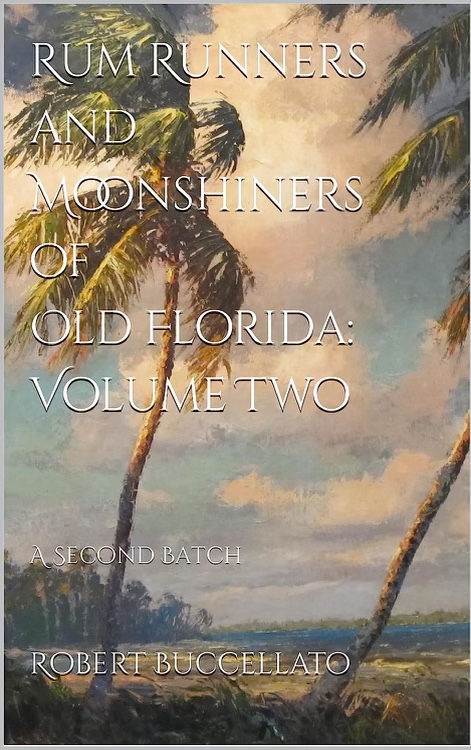
In Robert Buccallato’s other works about the state we’ve seen the evolution of Florida from small town oriented and reactionary to urban megastate. In Finding Dan McCarty, Buccallato brilliantly articulates an era of Florida politics and growth where the counties of South Florida who were driving the state’s economic growth were in a tussle to wrestle political control away from the largely rural northern part of the state. This work can be considered a precursor to that book, a prequel if you like.
The elements for a modern Florida and the explosive growth in relevance of southern Florida were intertwined with prohibition. While the common themes of land speculation, draining of the Everglades and an automobile and plane infused tourist-boom are given credit for the shift in the state, the prohibition era played an important role.
Buccallato’s knowledge of Florida History is among the sharpest around. This period of Florida’s evolution hasn’t been appreciated enough as it played a critical role in crafting a state that was attractive for outsiders and ready to boom after World War II. This era helped make southeast Florida a more cosmopolitan melting pot than had been seen in the state’s history with migrants from the Northeast and Midwest as well as foreign immigrants. The Tampa area also grew similarly.
What came out of the prohibition era was a more diverse state and one whose population was changing. While it took the leadership of the state decades to understand the changes and adjust accordingly, everyday life in Florida outside the small rural towns of northern Florida was never the same. While prohibition was undoubtedly a mistake spurned by an era of anxiety towards urbanization and immigration it shaped Florida for decades to come.



 The Florida Squeeze