
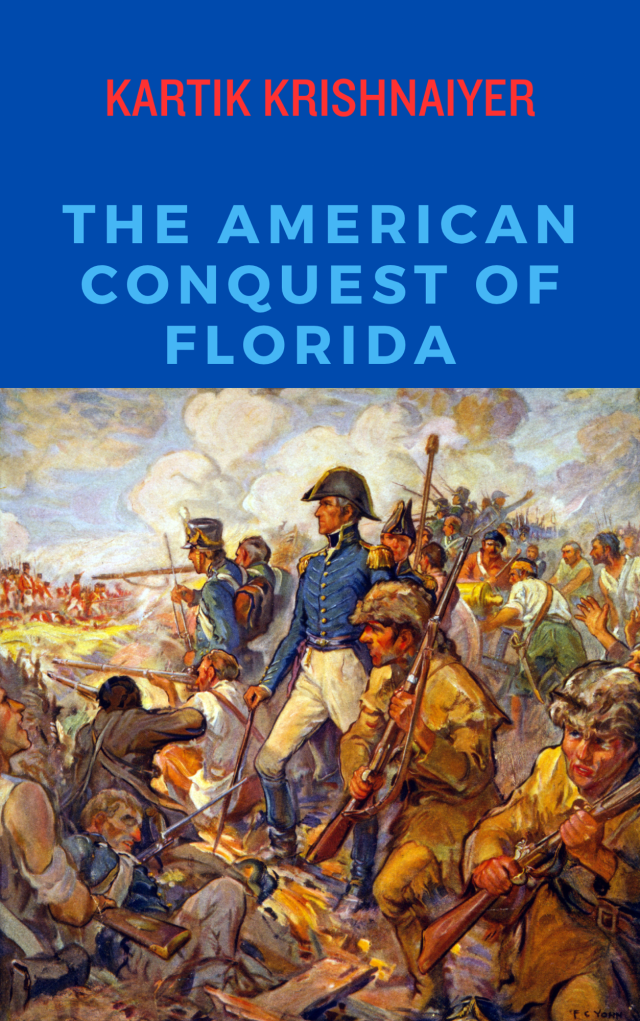
For Black History Month, we’re sharing this excerpt from my most recent book, The American Conquest of Florida.
The ultimate showdown over the future of Florida would take place on the banks of the Apalachicola River in Florida’s panhandle. The site is in present day Franklin County.
John and Thomas Forbes
The Forbes brothers were Scottish traders that took control of a company that traded extensively with the natives thanks to a relationship with Alexander McGillivray. They traded extensively in Florida and set up the original Prospect Bluff fortification between 1804 and 1806. It was set up as a fortified trading site.
From 1804 to 1817 the Forbes brothers dominated trade with the natives in Florida. The Spanish authorities defended the brothers’ company and its duty-free status as they saw it as a way of keeping American traders and therefore American incursions out of the colony.
British takeover the site
Prior to the British takeover of Pensacola in 1814, Captain George Woodbine of the Royal Marines occupied the site. He then ordered the building of a massive fort with a large moat. To man the fort beyond the 100 British regulars, Woodbine attracted Creek, Seminoles and runaway slaves to use the location as a base with which to raid the United States settlements and plantations.
After occupying Pensacola, the British were able to attract local slaves to make the trek about 120 miles to help staff the fort. The plan was to use the fort to launch a British invasion of Georgia when news of the Peace of Ghent arrived, ending the War of 1812.
Sir Edward Nichols of the Royal Marines who was a committed abolitionist supervised the construction of a second fort at the confluence of the Apalachicola, Chatahotchee and Flint Rivers. But it was the first fort, at Prospect Bluff about 60 miles south of the Georgia-Florida line, that continued to be a standing ground for runaway slaves and natives.
The British withdrew at the end of the war, but purposefully left all their weapons, and accepted the natives and the runaway slaves as “British subjects.” This ostensibly gave them the protection of the British flag.
Nichols was determined to give the runaway slaves and natives the best possible chance to survive. Whether this represented official British policy or not is not clearly recorded, but one thing that is certain is that at this point in time attitudes in the British empire were decidedly turning against slavery.
Florida had been a repository for runaway slaves since the 1690’s and that further intensified after the election of Thomas Jefferson in 1800. And while the Spanish were no longer encouraging runaways, as they had between 1693-1763, they weren’t exactly rounding them up and returning them to the United States either.
In addition, the runaway slaves set up a series of farms around the river to supply the fort and its inhabitants with food. This also helped the natives who previously knew little about domestic farming and relied more on hunting for food.
From the British perspective, while they were now out of the conflict, the African-Americans had proven to be loyal allies. If they could not emancipate them the way Cockburn had in his Fort Peter operation, they felt leaving them in a position to fight off the American slaveholders was worth the cost of some heavy artillery and armaments.
Andrew Jackson responds to the fort
In early 1816, Andrew Jackson complained to the Spanish directly about the fort.
Writing to West Florida’s Spanish Governor Mauricio de Zúñiga, Jackson said:
Whether that fort has been built by the government of Spain — and whether the negroes, who garrison it, are considered subjects of his Catholic Majesty — and if not by the authority of Spain — by whom, under whose orders, has it been established?
Secret practices to inveigle Negroes from the frontier citizens of Georgia as well as from the Cherokee and Creek nations of Indians are still continued by this Banditti [sic; he means the garrison] and the Hostile Creeks. This is a state of things which cannot fail to produce much injury to the neighboring settlements and incite Irritations which may ultimately endanger the peace of the nation and interrupt that good understanding that so happily exists between our governments.
The forthcoming reply from Zúñiga did not satisfy Jackson and he went forward with plans to destroy the fort.
Fort Scott- a US staging ground
Jackson ordered the construction of Fort Scott which was just over the border into Georgia – not far from the second fort the British had constructed in 1814-15, which was just over the border into Florida.
The fort became operational in April 1816.
Supplying the fort became problematic and the US decided to ship supplies up the Apalachicola River through Spanish West Florida. This was an obvious challenge to Spanish sovereignty in the area, but Zúñiga did nothing to stop the shipments.
However, the natives and runaway slaves manning the Prospect Bluff site fired upon a supply ship on April 27, 1816 giving Jackson the pretext he needed for an attack.
In fact the southern press played along. Among the newspapers to opine on this subject was the Savannah Journal which editorialized about the threat to the southern US posed by the fort.
It was not to be expected that an establishment so pernicious to the Southern states, holding out to a part of their population temptations to insubordination, would have been suffered to exist after the close of the war . In the course of last winter, several slaves from this neighborhood fled to that fort; others have lately gone from Tennessee and the Mississippi Territory. How long shall this evil, requiring immediate remedy, be permitted to exist?
As a result Jackson ordered United States Brigadier General Edmund P. Gaines to prepare for an all-out assault on the fort.
The attack on Negro Fort
The attack which came on July 27, 1816 was the first major engagement of what would become 42 years of war in Florida with some intermittent pauses.
The fort was occupied at the time by about 330 people. With the experience of being colonial marines, several of the former slaves or natives took leadership roles, to where a disciplined hierarchy was developed within the unit. The leaders came from different backgrounds and one was a free African-American named “Prince” who had fought the Americans in the Patriot War several years earlier. Prince also was an officer in the British defense of Pensacola. Another commander was Garçon, a former slave in Pensacola who had escaped to freedom.
American navy gunboats made their way up the Apalachicola River toward the fort and by June 27 were in position for an attack. We have to consider at the time the Apalachicola River was a major waterway, a highway of sorts from the Gulf of Mexico into the interior of the country. As we’ve discussed above, the waterway was critical for American supplies both for settlers and military posts. So from an American perspective the Negro Fort had to be eliminated.
Gaines requested a surrender but Garçon instead refused and raised the Union Jack stating that the fort was to be held on the orders of the British Royal Marines.
The United States forces were heavily armed but even during the War of 1812, they had not faced that many forts, this well-built and supplied. The British had indeed left the natives and African-Americans with a fighting chance to defeat the Americans.
Therefore, the US called in its heaviest available cannon guns and artillery.
During the daytime on June 27, the US used a heated shot cannonball launched from a ship against the fort, igniting the powder magazine in the fort and instantly killing 334 people. It has been a lucky shot and because the fort was so well supplied, that contributed to the devastating consequences.
General Gaines recorded the scene later for his report:
“The explosion was awful and the scene horrible beyond description. You cannot conceive, nor I describe the horrors of the scene. In an instant lifeless bodies were stretched upon the plain, buried in sand or rubbish, or suspended from the tops of the surrounding pines. Here lay an innocent babe, there a helpless mother; on the one side a sturdy warrior, on the other a bleeding squaw. Piles of bodies, large heaps of sand, broken glass, accoutrements, etc., covered the site of the fort… Our first care, on arriving at the scene of the destruction, was to rescue and relieve the unfortunate beings who survived the explosion.”
A few survivors were able to make their way south, and there were also some free blacks in the surrounding areas that were not at the fort, who then fled southward. Those who did survive the blast were captured and executed by order of General Jackson. This included Garçon.



 The Florida Squeeze