
On September 24, 2001, US Airways announced it was shutting down its successful MetroJet subsidiary in the wake of the attacks of September 11. From a Florida perspective this is significant, because with the shuttering of MetroJet, outside a later attempt to make Fort Lauderdale an international hub, US Airways ceded much of its dominant market position in Florida.
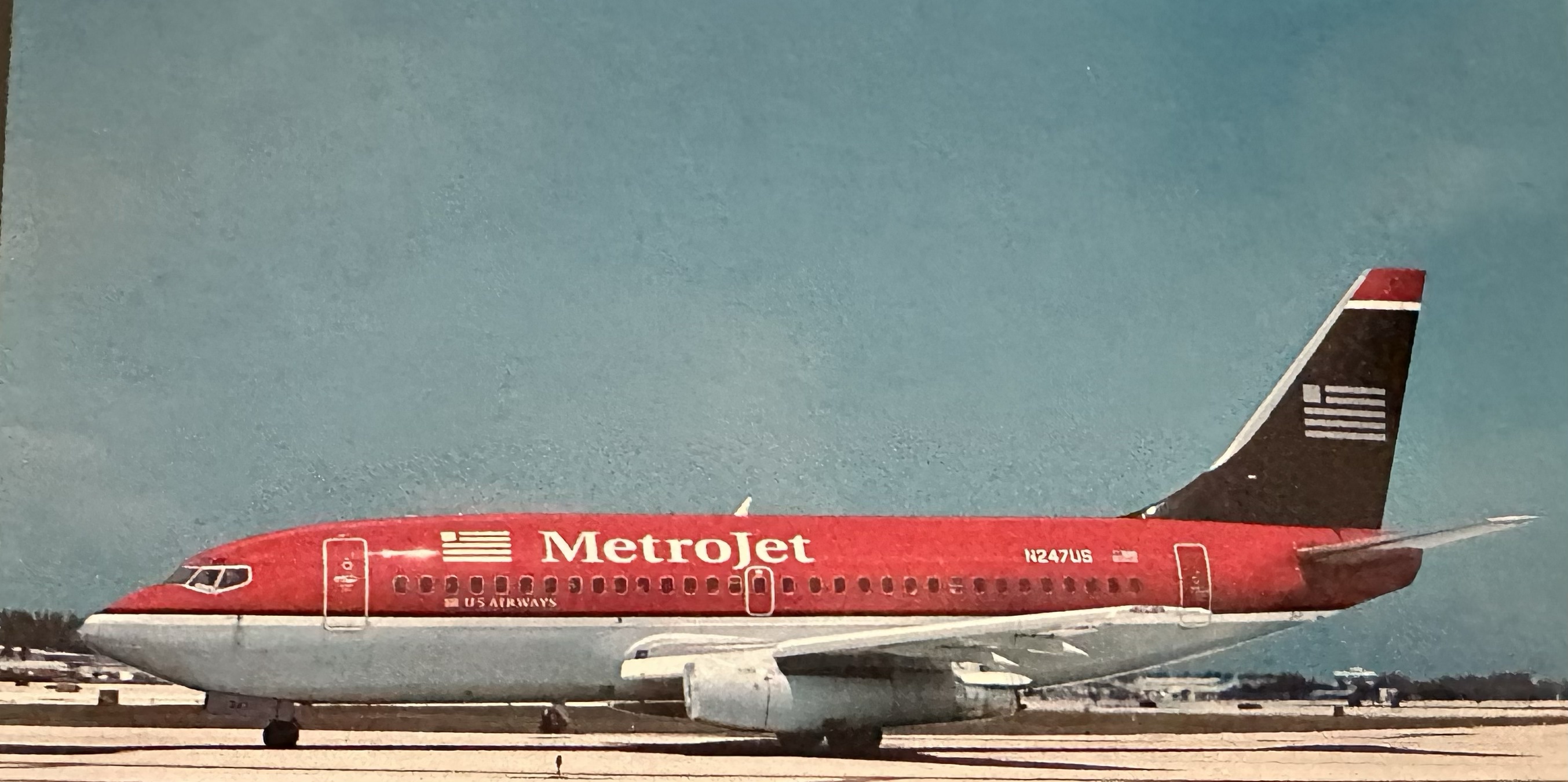
MetroJet is particularly memorable because of the distinguishable red paint scheme though the livery and tail design (outside the top red area) was identical to mainline US Airways. At the same time Delta had “Delta Express.”
These “airlines within an airline” were concepts that became a thing in the 1990’s with Delta, US Airways, Continental and United all launching low-cost subsidiaries that flew frequently to counter the growing strength of Southwest Airlines.
Delta and US Airways efforts were based around Florida so we will focus on that today.
Delta’s “airline within an airline.” Delta Express basically took over Delta’s Orlando hub in 1996 and then gradually built an impressive point-to-point network from Fort Lauderdale with flights from additional Florida cities to the Northeast and Midwest.
Below is the Delta Express network in September 2011 right before 9/11. Most flights touched Orlando or Fort Lauderdale but other flights reached Fort Myers, Tampa and West Palm Beach.
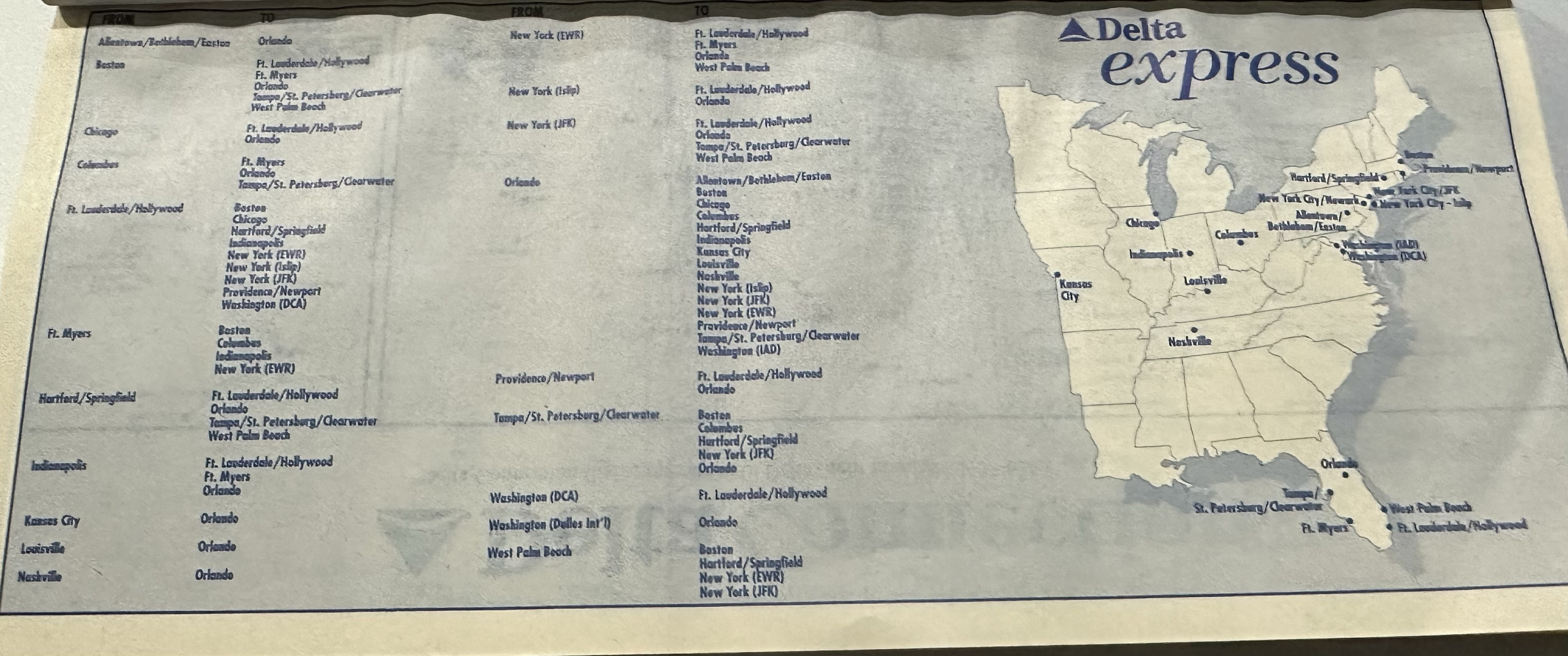
As the above flight list indicates, every Delta Express flight touched Florida. A focus was on Florida to Northeast flights but eventually the Midwest was served. Delta Express with its frequent nonstop point-to-point flights even flew from Fort Lauderdale and Orlando to Chicago-O’Hare…huge hubs for United and American, but routes many forget Delta had dominated in the 1980’s before pulling off both routes in the early 1990’s. Boston was served from five Florida cities.
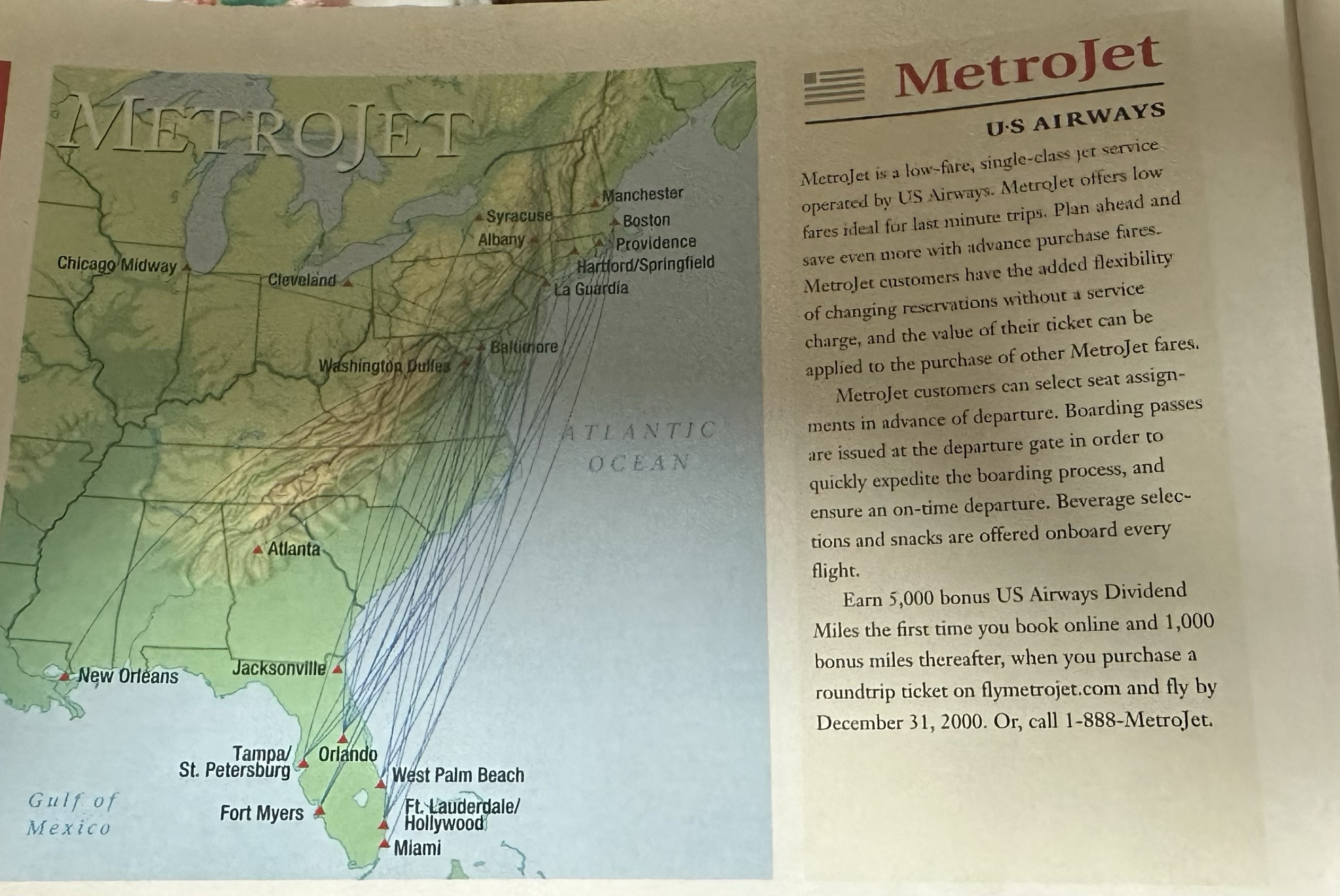
MetroJet on the other hand, while fairly Florida-centric wasn’t entirely based around Florida.
Why did Delta Express and Metrojet both begin?
When Southwest Airlines started service to Florida in January 1996, everything changed for US Air and Delta. Intra-Florida flying between large cities except Miami ( this means Tampa, Orlando, Fort Lauderdale and Jacksonville) was now dominated by Southwest, similar to what had happened previously in Texas and California.
Complicating matters more for US Air was Southwest invading Baltimore. At the time US Air was the primary airline in the National Capital region with a large hub at Baltimore as well as large operations at Washington’s Dulles and National Airports. This left US Air’s network with tier 2 linkups including a large operation from Tallahassee to every major Florida airport, but crippled its core Florida business.
After rebranding as US Airways in 1997 in an attempt to look a more global carrier, the airline launched MetroJet in 1998, a low cost single-class service that would link large east coast cities. The initial focus was fighting Southwest in Baltimore.
The airline featured high-frequency service between major east coast metropolitan areas and lasted from 1998 to 2001. Orlando eventually became a focal point for operations, having the second most MetroJet destinations behind Baltimore from 1999 to 2001 (placing it ahead of Washington-Dulles). Fort Lauderdale and Tampa also saw frequent MetroJet service, with Fort Myers, Jacksonville, Miami and West Palm Beach also being served at various times.
For Delta, Southwest ramping up Orlando service was bad news. They began Delta Express as an Orlando-centric carrier but gradually decided to convert many Delta mainline flights out of Fort Lauderdale to Delta Express and eventually served the Midwest from multiple Florida points. Every flight was flown on an aging 737-200 which was the same exact plane US Airways was using for MetroJet.

MetroJet was a victim of its own success. By focusing on large urban markets, MetroJet which had lower per unit costs than US Airways mainline cannibalized passengers from its parent carrier.
Since MetroJet gave the same frequent flier benefits US Airways did, it actually hurt the mainline operation. For example, MetroJet’s lower fares from Baltimore and Washington-Dulles attracted US Airways fliers from Washington-National. In reality, the “airline within an airline” did more to undercut its parent than fight Southwest.
So after 9/11, US Airways used its contractual force majeure clause negotiated in the collective bargaining process to shut down MetroJet and reintegrate its services into US Airways.
As for Delta Express, it was eventually replaced by Song, which is a story for another time.
The long and short of that shift was Delta was no longer concerned about fighting Southwest for low-cost passengers but instead fighting newly-founded JetBlue for younger and more business-savvy ones. Song’s Focus Cities were New York-JFK, Orlando, Fort Lauderdale and Boston…the same exact cities JetBlue has large operations in to this day.

So this will have to be a story for another day.






 The Florida Squeeze
I’m happy to see that carriers have largely abandoned the carrier-within-a-carrier model. Metrojet…Song…Ted…none of them did more than cannibalize the parent carrier.
LikeLike