
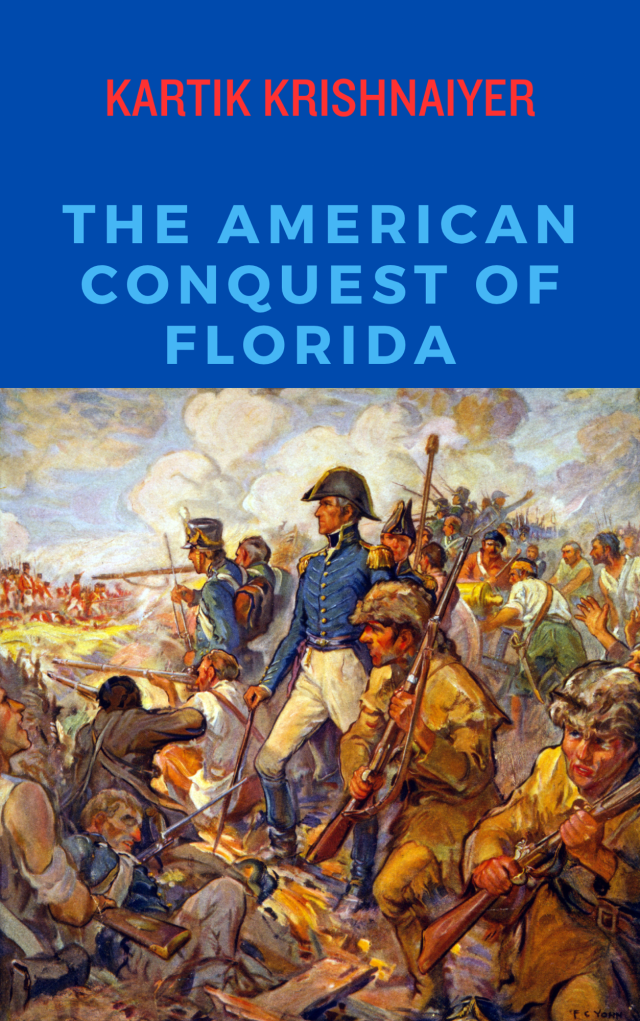
Editors Note: This is an excerpt from Florida and the British Before the American Revolution. Kartik Krishnaiyer’s most recent book, Florida and the American Revolution is now available from Amazon.
During the 1600’s Florida was a prosperous colony. Despite lacking in natural resources, the Spanish crown saw Florida as a critical component in protecting its maritime trade routes from the mother country to colonies in the Caribbean as well as in North, Central and South America.
St Augustine, though by Spanish colonial standards was a poor town, it was in reality among the richest cities in what is now the United States because of the amount of trade that came through it. It was also remarkably cosmopolitan with a mix of ethnicities in addition to the Spanish. At any given time in St Augustine you could find Portuguese, Dutch, Germans, Italians, French, Jews, free blacks and Native Americans in addition to African Slaves. St Augustine was the most cosmopolitan place in North America.
American history, it can be argued, would be viewed in a different light if multicultural St Augustine were seen as a critical early settlement instead of let’s say Jamestown or Williamsburg with its populations exclusively from the British Isles or Northern Europe.
West of St Augustine and similar to the Spanish-governed areas in present-day California, New Mexico and Texas, a mission culture sprung up pacifying and converting Native Americans to Catholicism.
As part of this policy the Spanish had established several missions in-between St Augustine and the Apalachicola River. The missions served the purpose of converting the native population to Catholicism to create a bulwark against the potential colonization of the area by England or France. Spain had claimed much of what is now the Southeastern United States as part of Florida in the 1600’s. But following the abandonment of Parris Island and Saint Elena to the north after the English raid of 1586, Spain never effectively controlled more than the strip from St Augustine to what is now Albany in southern Georgia in addition to the coastal settlement of Pensacola, which was founded in 1698.
The missions functioned well throughout much of the 1600’s, with the settlements of Apalachee and Timucua connected to St Augustine via the El Camino Real. While the missions were a form of forced conversion by the Spanish and native peoples were adversely impacted by disease brought by Europeans, the interaction between the Spanish and Florida’s native population could be considered largely benign when compared to what would happen to natives once the United States set its sights on Florida years later.
Economically, Florida prospered as missions were agricultural in nature and St Augustine grew as an important trading center and port at the northern end of Spain’s Caribbean holdings. However, it must be noted during this entire period Florida was never self-sufficient. Annual provisions from modern-day Mexico were critical. Corn however grown on the missions helped sustain St Augustine and gave Spanish Florida a degree of economic independence for the only time in its history.
But as Florida prospered the English began settling further and further south down the Atlantic coast. The settlement of what is now North Carolina took place in 1653 and Charles Town, now Charleston, South Carolina was founded in 1670. Nassau in the Bahamas became English in 1666. Florida was becoming a remote outpost of Spanish power on the Atlantic squeezed on two sides by English control.
In 1662, St Augustine faced a famine when provisions from Mexico and corn from the missions and other points in western Florida didn’t arrive in a timely fashion. This led to an internal political battle which is better left described in texts that detail Spanish Colonial Florida. For our purposes however it left St Augustine vulnerable and the English, never far away, were ready to take advantage.




 The Florida Squeeze