
The following is an excerpt from my new book Lincoln’s Ghost: Our Haunted Presidency.
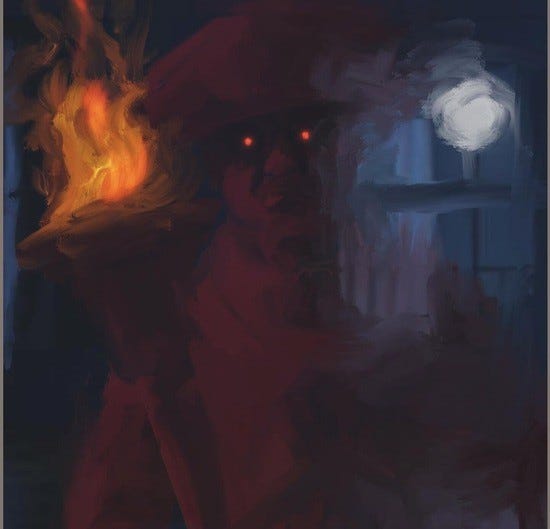
In the darkness of a modest rented single room John Flammang Schrank, a Bavarian-born saloonkeeper was awakened with a terrible fright. Rising high above him was the pale and slowly decaying corpse or spirit of a former President. Trying desperately to shield his face from the penetrating gaze of the dead chief executive, Schrank’s ears seemed to be filled with the raging voice of William McKinley.
William McKinley had been murdered by an assassin’s bullet in 1901, not long into his second term. Yet, here he was haunting Schrank’s New York apartment. The covers atop Schrank’s head seemed to glow with brilliant dilaudid green light. It wasn’t white, it didn’t feel pure, and it carried with it rage and corruption. Standing no longer, the German immigrant went to face the light, the ghost was now inches from him, and McKinley’s eyes seemed to consume John Flammang Schrank. Never again would he know peace or sanity.
Schrank was born in Erding, Bavaria, on March 5, 1876. He emigrated to the U.S. at the age of 9. His parents died soon after, leaving Schrank to work for his uncle, a New York tavern owner and landlord. Upon their deaths, Schrank’s aunt and uncle left him valuable properties, with the expectation that Schrank could live a quiet and peaceful life. Schrank was heartbroken, not just because he had lost his second set of parents, but also because his first and only girlfriend Emily Ziegler had died in the General Slocum disaster on New York’s East River. Schrank sold the properties and drifted around the East Coast for years. He became profoundly religious, and a fluent Bible scholar, whose debating skills were well-known around his local watering holes and public parks. He wrote spare and vivid poetry. He spent a great deal of time walking around city streets at night but caused no documented trouble.
According to Schrank, he had been visited one night by the ghost of assassinated President William McKinley who had told him that Theodore Roosevelt (his vice-president at the time) had masterminded the assassination. Schrank claimed that McKinley’s ghost had visited him more than once and, on the most recent haunting, had told him to stop Roosevelt from winning a third term.
“ NO THIRD TERM!” the specter of McKinley cried out.
Schrank then bought a gun and began following Roosevelt on his presidential tour. Among Schrank’s papers was a journal that he had kept which described his obsession with Roosevelt. After passing up another opportunity in New Orleans, Schrank followed Roosevelt to Minneapolis and shot him after hearing that he was at the Gilpatrick Hotel.
When he was arraigned in court in Milwaukee on November 12, 1912, he pled guilty to the shooting stating “I didn’t mean to kill a citizen, Judge. I shot Roosevelt because he was a menace to the country. He should not have a third term. I did not want him to have one. I shot him as a warning that men must not try to have more than two terms as President”.
Roosevelt, who had left office three and a half years earlier, was running for president as a member of the Progressive Party.
During a Roosevelt campaign speech in Milwaukee, Wisconsin, Schrank, who had been stalking him for weeks, shot Roosevelt once in the chest with a .38-caliber Colt Police Positive Special Model 1905 revolver. The 50-page text of his campaign speech folded over twice in Roosevelt’s breast pocket and a metal eyeglasses case slowed the bullet, saving his life. Schrank was immediately disarmed, captured, and might have been lynched had Roosevelt not shouted for Schrank to remain unharmed.
As an experienced hunter and anatomist, Roosevelt correctly concluded that since he was not coughing blood, the bullet had not reached his lung; he declined suggestions to go to the hospital immediately. Instead, he delivered his scheduled speech. His opening comments to the gathered crowd were, “Friends, I shall ask you to be as quiet as possible. I don’t know whether you fully understand that I have just been shot — but it takes more than that to kill a Bull Moose.”
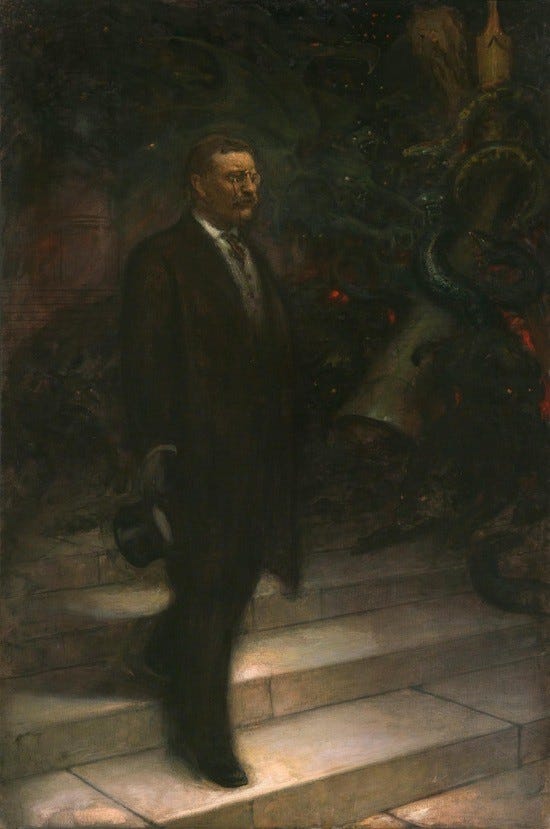
Ben Hecht was covering the speech for the Chicago Journal and later described it in his autobiography A Child of the Century:
“Surgical bandages wrapped the thick torso under his shortcut-away coat. Teddy’s voice was fainter and squeakier than I had ever heard it. He held up his hand for silence…and we gave him the auditorium. He looked as if he might topple over if he kept standing too long.”
Afterward, probes and an x-ray showed that the bullet had lodged in Roosevelt’s chest muscle, but did not penetrate the pleura. As doctors concluded that it would be less dangerous to leave it in place than to attempt to remove it, Roosevelt carried the bullet with him for the rest of his life.
Soon after the assassination attempt, psychologists examined Schrank and reported that he had “insane delusions, grandiose in character,” declaring him to be insane. At his trial, the would-be assassin claimed that William McKinley’s ghost had visited him in a dream and told him to avenge his assassination by killing Roosevelt. Schrank was committed to the Central State Hospital for the Criminally Insane in Waupun, Wisconsin, in 1914. He remained there for 29 more years until he died on September 15, 1943, of bronchial pneumonia. His body was donated to the medical school at Marquette University (now the Medical College of Wisconsin) for anatomical dissection.
As it would turn out Schrank”s last words were a sly reference to the assassination. The guards assigned to transfer the ill and elderly Schrank to Central State Hospital commented that the surrounding countryside was good for hunting and fishing. After one of them asked Schrank if he ever hunted, his simple reply was: “I only hunt Bull Moose”.





 The Florida Squeeze