
Through the year American Airlines has generally done fewer point-to-point type flights than other legacy US carriers after the hub and spoke system really developed in earnest in the 1980’s. But oddly, AA generally had Fort Lauderdale as a strange destination in-between hub and spoke for a ten year period between 1999 and 2009. So therefore, we’re calling it a (sort of) focus city.
Fort Lauderdale as a spoke next to an AA hub
American opened its Miami hub in 1990 with incumbent carriers at MIA, Eastern and Pan Am both near death. Fort Lauderdale (FLL), just 21 miles up the road only had AA service at the time to Dallas/Fort Worth and Raleigh/Durham, both hubs for American. In 1991, Fort Lauderdale got two daily nonstops to AA’s Chicago-O’Hare (ORD) hub. For years, Delta Airlines despite not having a hub on either end was the leading carrier on FLL-ORD but by 1991 was down to a single daily flight on the route. In 1992, Fort Lauderdale gained nonstops to American’s Nashville hub. By 1996, both Nashville and Raleigh/Durham were de-hubbed by American and Fort Lauderdale was left with just Dallas/Fort Worth and Chicago-O’Hare flights. Meanwhile, American was turning Miami into a fortress hub.
In 1997, American added daily nonstops from Fort Lauderdale to both Los Angeles and San Juan. Technically both were AA hubs, but the flights indicated a commitment to the market. In 1998, with the collapse of Carnival Airlines/Pan Am II, nonstops from New York-LaGuardia and Boston to Fort Lauderdale were added as were flights from LaGuardia to Orlando, Tampa and West Palm Beach. This was part of American’s new “cornerstone” strategy to focus on big metro areas (New York, Los Angeles, Chicago, the DFW Metroplex, Miami-Fort Lauderdale and Boston). Thus as the second airport in the Miami area, FLL took on added importance.
This was a sharp reversal from AA’s strategy from 1986-1996 which believed smaller, less congested airports like Nashville, Raleigh-Durham and San Jose (CA) made perfect hubs. The reality is business travelers did not want to connect in those places. American therefore went with a metro-heavy strategy in 1997, until it absorbed TWA’s St Louis hub in late 2001.
American’s “cornerstone” strategy makes Fort Lauderdale a focus 1999-2001

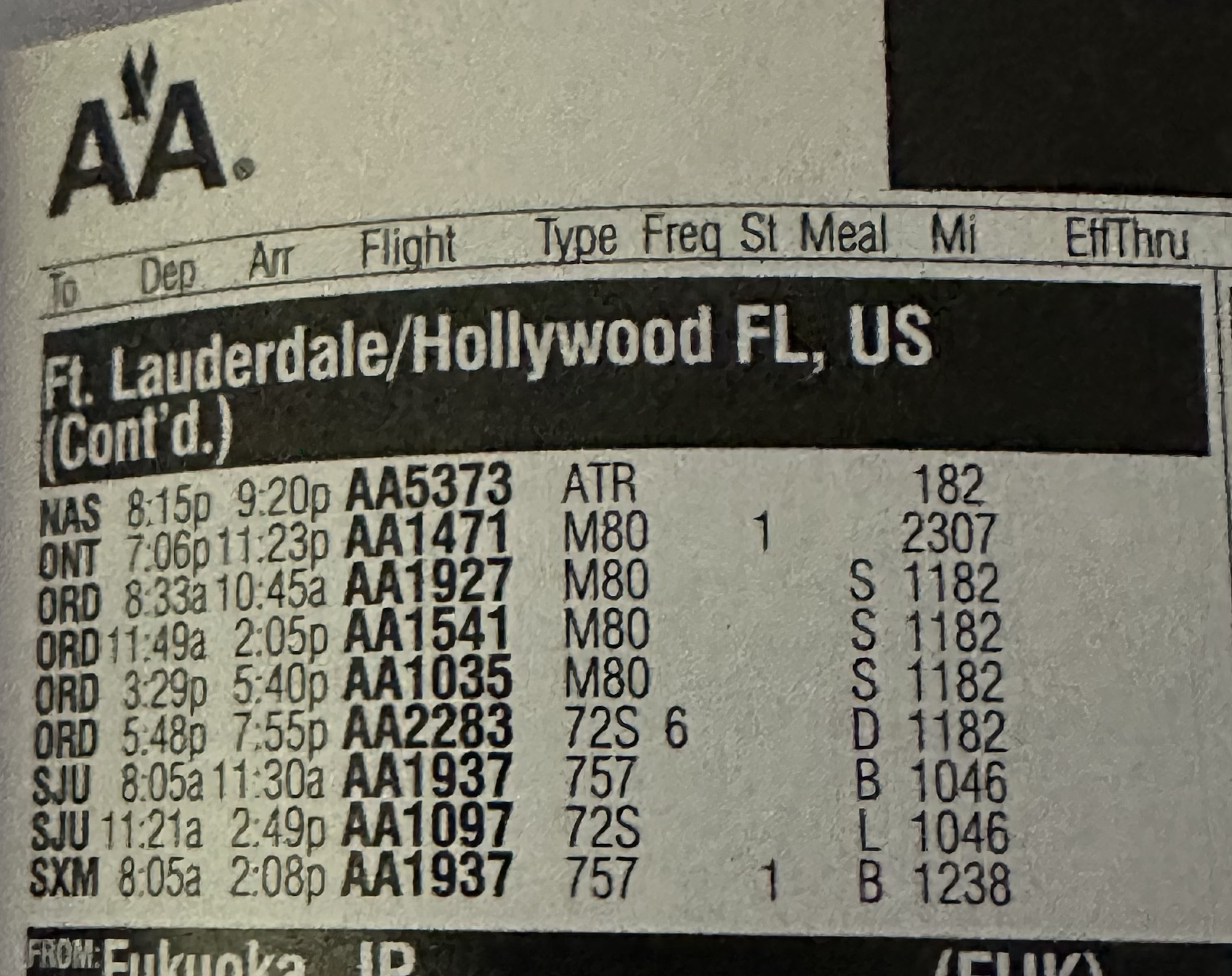
By early 2000, Fort Lauderdale had nonstops to Boston, Chicago-O’Hare, Los Angeles, Nassau (American Eagle), Newark, New York-LGA, San Juan and Washington-National. Freeport on American Eagle would be added later in 2000. This made FLL most certainly some sort of focus city in the AA network.
With the acquisition of TWA in early 2001, St Louis was added (TWA continued to fly until late 2001 but was now branded TWA, an American Airlines company) and the sole competitor on the San Juan route was eliminated.
Then 9/11 happened. American lost two planes on 9/11 and like all US airlines cut back for a time. Though it must be said AA’s cutbacks weren’t as severe as Delta and US Airways cutbacks, as their networks were largely east coast focused. Still air travel along the eastern seaboard in particular, plunged.
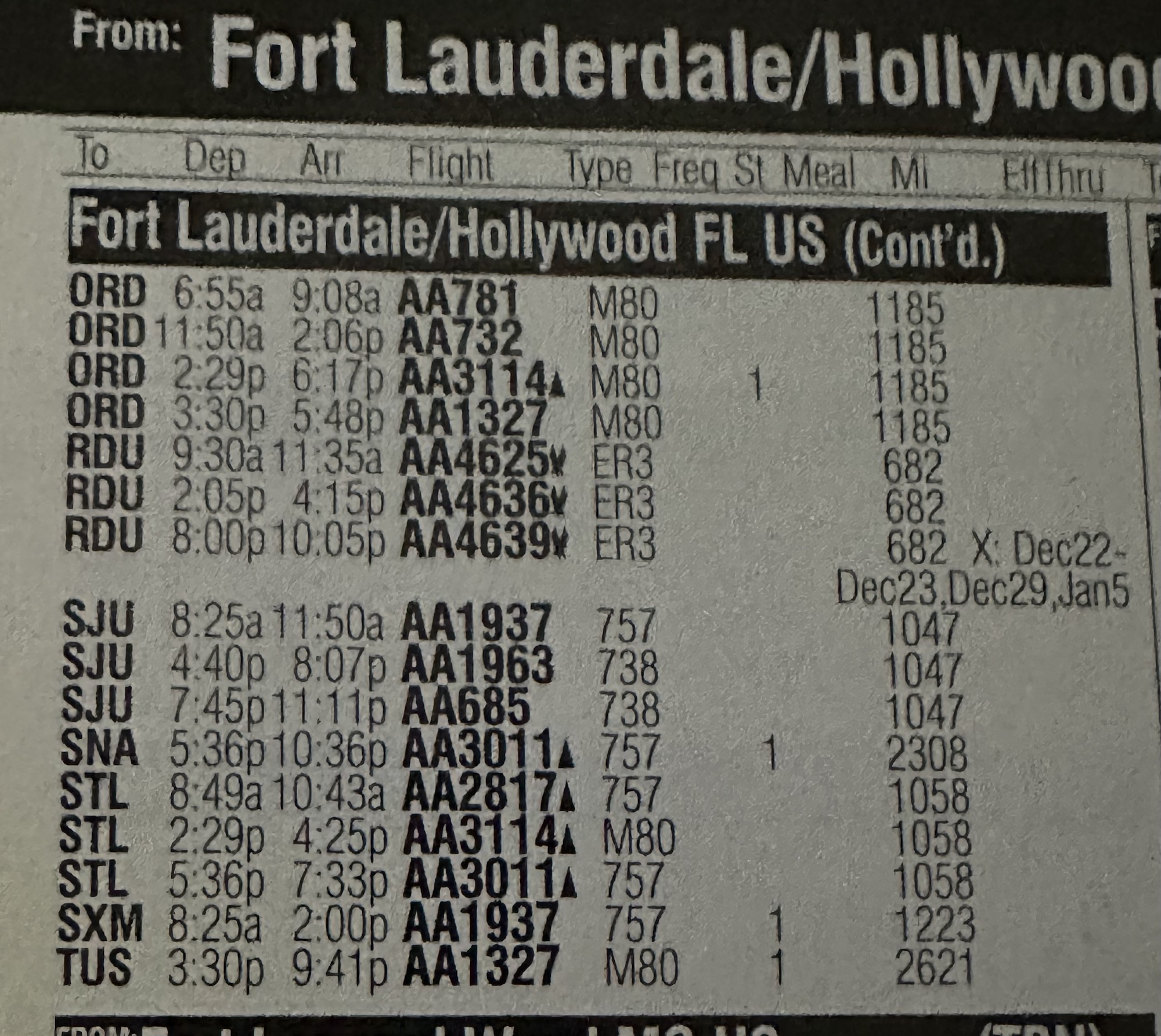
The first timetable after 9/11 indicated Washington-DCA, Newark and Freeport had been dropped but oddly Raleigh/Durham was added as an American Eagle route using regional jets. Planned service to Caracas, announced in Summer 2001 to begin December 15 did not start until 2003.
International flights 2002-2009
In hindsight, it’s odd that American decided to try its luck flying internationally from Fort Lauderdale between 2002 and 2009, given its large Miami hub next door. Yet it does make sense when you consider the number of AA Advantage members that used the MIA hub that lived in Broward and Palm Beach counties.
But much like American’s one-time effort to duplicate the most heavily traveled European routes from JFK with Newark service (London and Paris), AA decided to duplicate the best Miami routes to Latin America out of Fort Lauderdale. For a while it worked, but eventually Spirit’s FLL-Latin America buildup with low fares undid the idea.

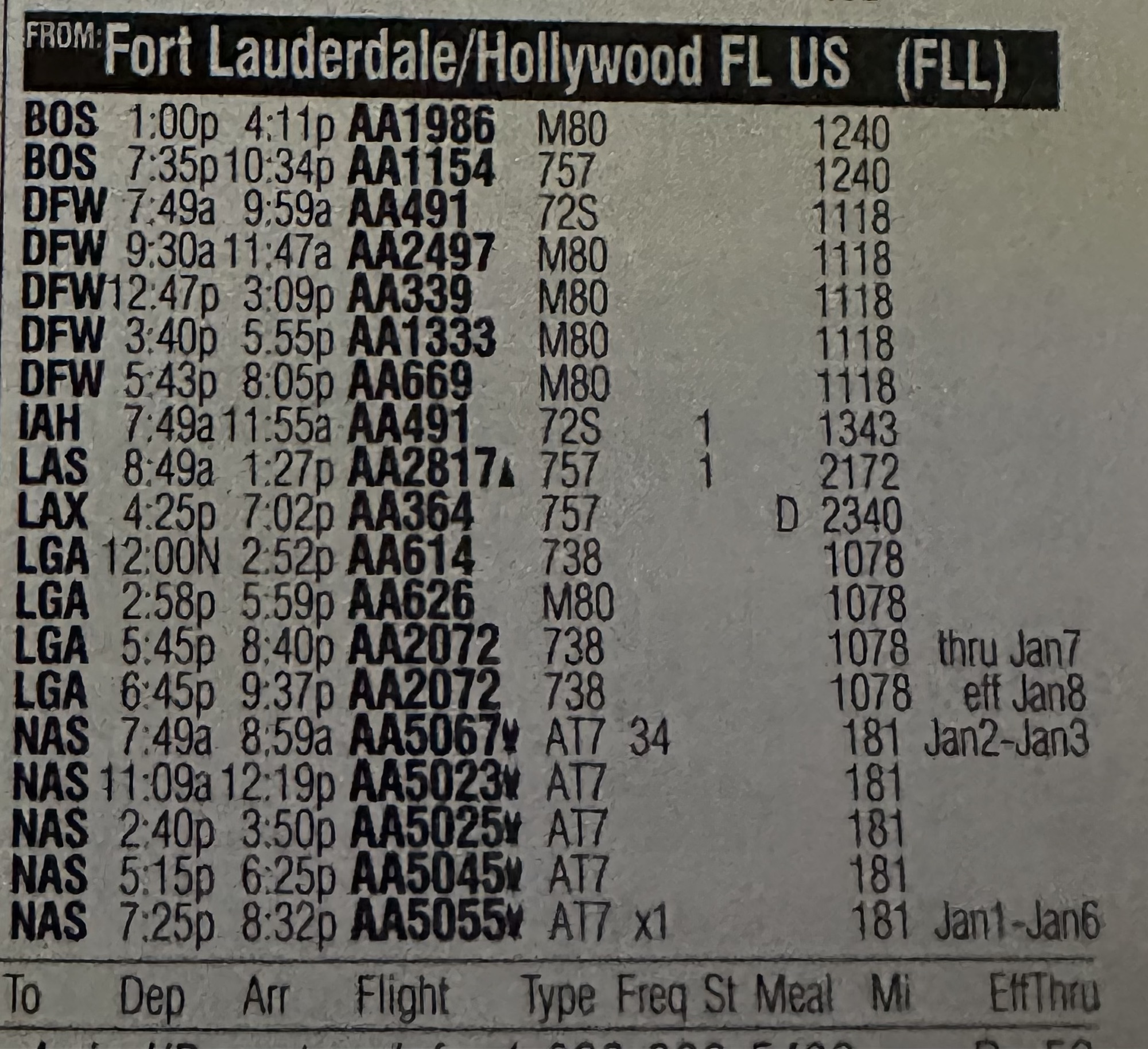
By mid-2003, American had added service from Fort Lauderdale to Caracas (announced in 2001 but pushed back after 9/11), Port-au-Prince and Santo Domingo. The above timetable image is from March 2004. By this time, Fort Lauderdale also was seeing increasing daily service to Boston (three times a day) and Los Angeles (four times a day). In the hub-centric American network, Fort Lauderdale at this point was a bonafide focus city where connections onward to five Latin/Caribbean destinations (including long-time Nassau and San Juan service) could be made.
By late 2007, Boston ( cut back by AA severely in 2005 when JetBlue ramped up), Caracas (political reasons) and the Eagle Raleigh/Durham route had been dropped (how this route lasted several years I can’t understand, but similarly Delta has flown FLL-RDU off-and-on but mostly on for 20 years now without a hub on either end) but San Jose, Costa Rica was added. Kingston would be added in 2008, but both Los Angeles and New York-LGA were down to a single daily flight, indicating FLL was no longer being used for connections but simply for origin and destination traffic.
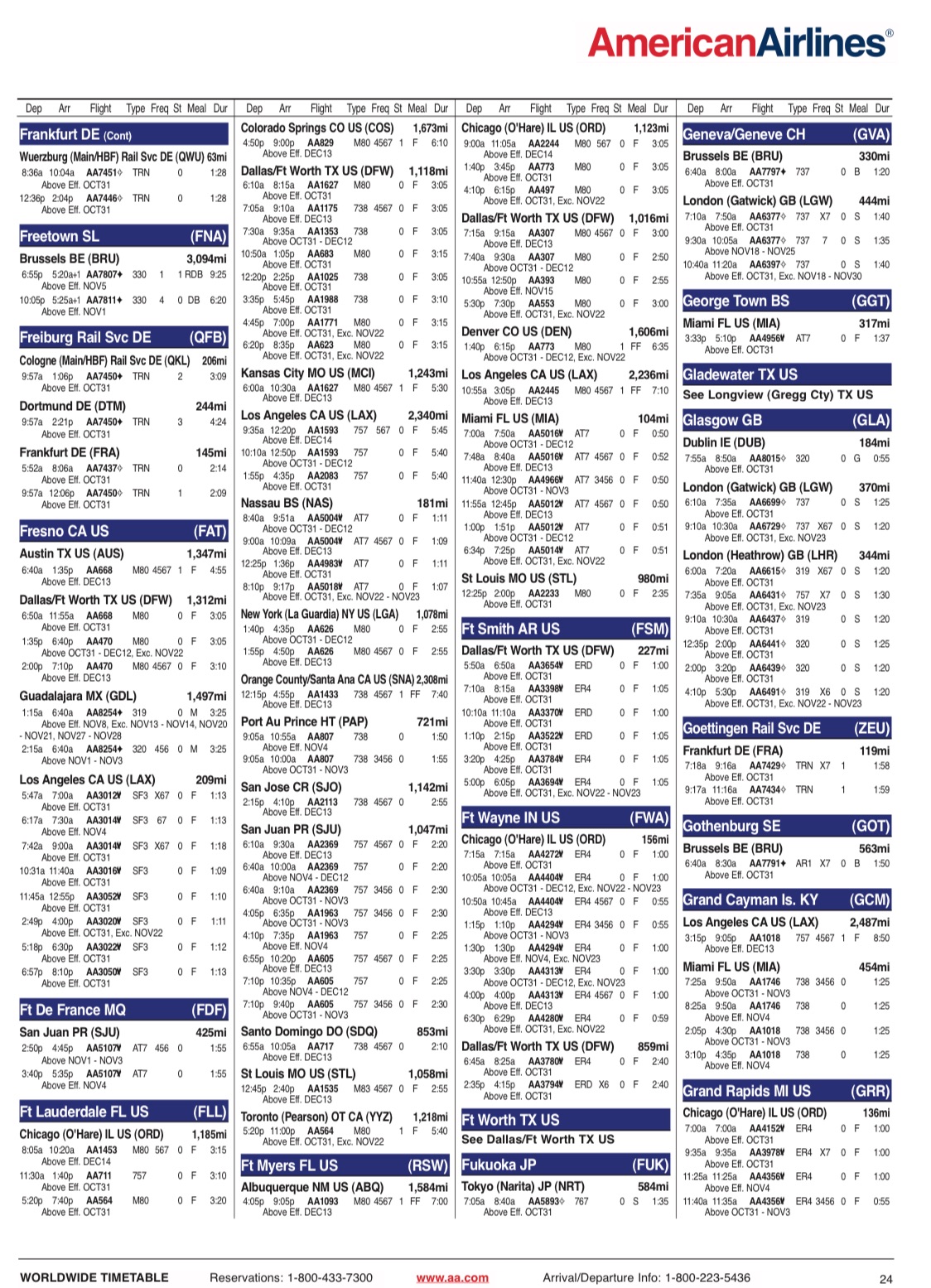
In late 2009, all non-hub FLL flying was wound-down except for Fort Lauderdale to Port-Au-Prince which continued to be flown until 2018 and then again in 2021 and 2022. St Louis was also dehubbed at this time while Fort Lauderdale’s flight to New York, was shifted to JFK. FLL has remained merely an AA spoke since.
Below schedule is from November 2011.







 The Florida Squeeze